
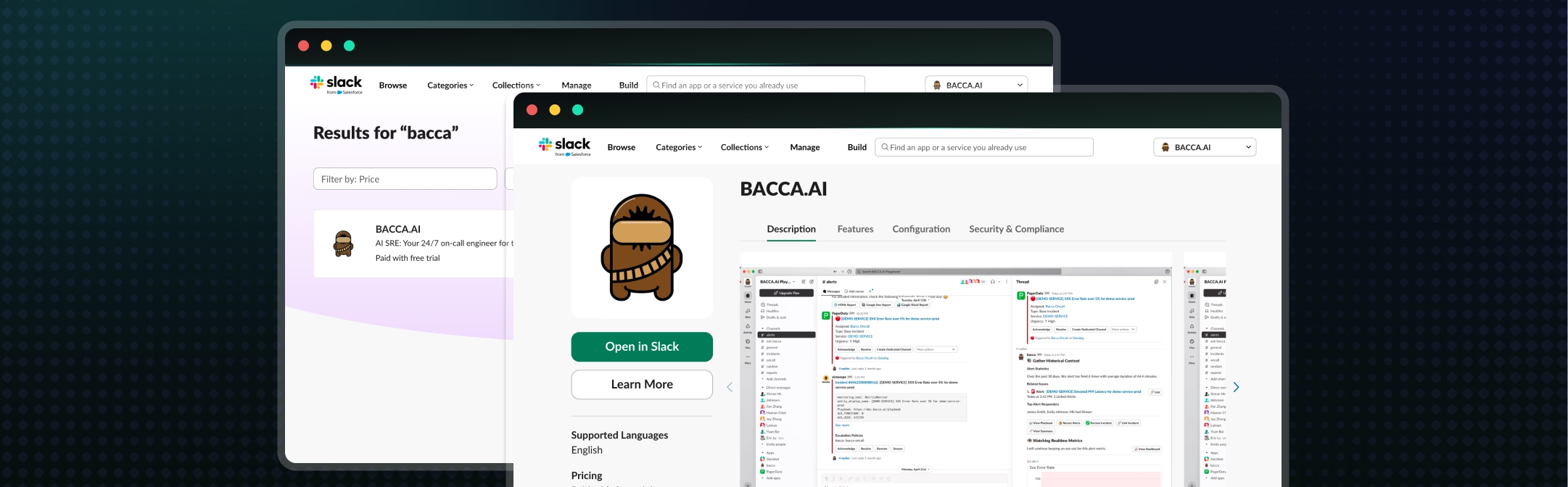
Bacca has been Slack-native since day one. Today, our official listing on the Slack App Marketplace brings intelligent incident response directly into the channels where your engineering teams already work.
More than just a security milestone, this listing is the ultimate validation of our core philosophy. To understand why we built Bacca natively for Slack, we have to look at how modern teams handle crises in complex distributed systems.
The Friction of High-Scale Firefighting
Within the AI SRE space, there are structurally distinct problem types — and you can see the difference in where the work actually happens.
In a low-scale environment, incidents rarely turn into a full-on Slack war room. They’re often a single, deterministic code issue: someone drops a link in the channel, opens the repo, and fixes the bug directly in an IDE or GitHub. Slack is mostly a notification layer — “I found it,” “PR up,” “merged,” “deployed.”
Bacca, however, is purposely built for high-scale, often consumer-facing infrastructure. Here, incidents emerge as aggregated service degradations affecting millions of users. These critical incidents are complex triage and mitigation problems where the immediate priority is containing the impact through actions like scaling the infrastructure or load shedding.
When these complex systems degrade, engineers instinctively gather in a Slack war room to coordinate. This is exactly where the friction begins. The tools required to investigate the outage live somewhere else. Engineers stop talking, open browser tabs for external observability platforms like Datadog or Grafana, and the collaboration splinters. Everyone is trying to fix the same issue, yet no one is looking at the same screen. During a high-severity incident, every context switch out of Slack adds minutes to the resolution timeline, and shared context is lost.
Bringing the Tools to the War Room
Incident resolution happens in Slack, and we believe the investigative tooling needs to live there, too. Effective mitigation requires communication and investigation to happen concurrently, in the exact same place.
Committing to this Slack-first approach gave Eng teams a significant structural advantage. It allowed us to focus entirely on building our core technology to ingest information and build knowledge about your system, rather than wasting valuable engineering cycles building a custom, detached web UI for firefighting. We brought the tools to the war room, rather than pulling engineers out of it.
Capturing Institutional Knowledge in Real-Time
Because Bacca lives natively in your channels, it actively absorbs this tribal memory. In enterprise environments, operational knowledge doesn't exist solely in code. It lives in Confluence pages, Jira tickets, Slack threads, and in the heads of your expert engineers.
Bacca bridges this gap by acting as a living Knowledge Graph. It continuously learns your system by ingesting conversations, observability telemetry, and postmortems to map your services and failure patterns. Instead of starting from scratch every outage, Bacca uses this Knowledge Graph to drive structured, evidence-based triage. Because it forms this deep contextual understanding, Bacca operates like a remote human SRE 24/7 ready to go. You simply @-mention Bacca in your incident channel to ask questions and investigate.
Firefighting Features in Action
By living where your team naturally communicates, this native architecture reverses the traditional notification model: if an action can happen entirely within Slack, it should. Bacca powers features built explicitly for high-stress operations:
- Mobile triage at 3 AM: Triage, investigate, and mitigate issues entirely within the Slack mobile app. When you are paged in the middle of the night, there is no need to fumble through complex observability platforms on your mobile browser.
- Real-time metrics: Bacca pulls live telemetry natively into the thread, updating automatically every 60 seconds. The entire war room watches the same data visualization evolve simultaneously, keeping everyone on the exact same page without leaving the chat.
- Context summarization: Engineers entering the war room 30 minutes late get a concise, automated summary of the current state, active hypotheses, and steps taken, allowing them to jump in and contribute immediately.
The Proof Point: Enterprise Ready
Our official listing on the Slack App Marketplace brings this vision full circle. For enterprise security teams, this milestone means Bacca can now be deployed with zero friction.
Independent reviewers rigorously tested every API permission, verifying that Bacca strictly adheres to the principle of least-privilege access controls. The review process also required close examination of critical details like LLM data handling and retention practices.
For enterprise customers, the practical impact is immediate. This official listing completely removes the "unreviewed application" warning, giving SRE teams a clear, pre-vetted path to deploy Bacca securely and bypass the usual manual procurement evaluations.
Every context switch during a critical outage costs time the team cannot recover. Incident tools should live exactly where the team naturally communicates. If your engineers open a Slack channel to coordinate their response, your investigative tooling should already be waiting for them there.
View our official listing on the Slack App Marketplace or book a demo at bacca.ai.
Eric Lu
Founder & CEO, BACCA.AI
🤝 A Note to Fellow Founders
We know firsthand the marketplace approval process involves many detailed technical reviews for early-stage startups. If you are a founder trying to get your application listed and want to swap notes on navigating the technical review process, please reach out directly. We are happy to share what we learned.
we will contact you soon