
Inside the $9.2 Billion funding difference creating an imbalance for engineering leaders
There are dozens of new AI tools launching every week. At BACCA.AI, we found ourselves trying to wrap our heads around the chaos.
We got curious. So we mapped over 150 companies across the AI landscape to answer a simple question: How many startups are helping us write code compared to those helping us keep that code running?
What we found was a massive imbalance.
The Multibillion-Dollar Gap
When we crunched the numbers, the difference between dollars invested in Code Creation vs Code Operations wasn't a small margin of error.
- $10.1 Billion in funding raised for tools to write code (Dev, Testing, Agentic IDEs).
- $836 Million in funding raised for tools to operate it.
Even excluding outliers like OpenAI and other foundational models, the ratio is staggering. For every $12 investors put into writing code, just $1 is invested in keeping it running.
We care deeply about eliminating problems for human engineers operating software, but we kept seeing the conversation skew toward tools designed to generate it.
Understanding this imbalance is easier if you zoom in on the AI SRE landscape—a critical subcategory within the broader AI DevOps ecosystem. While vibe coding has been the darling of the industry for years, AI SRE is the discipline of using those same LLMs to fix, secure, and maintain production environments, eliminating the pain of the 3 a.m. page.
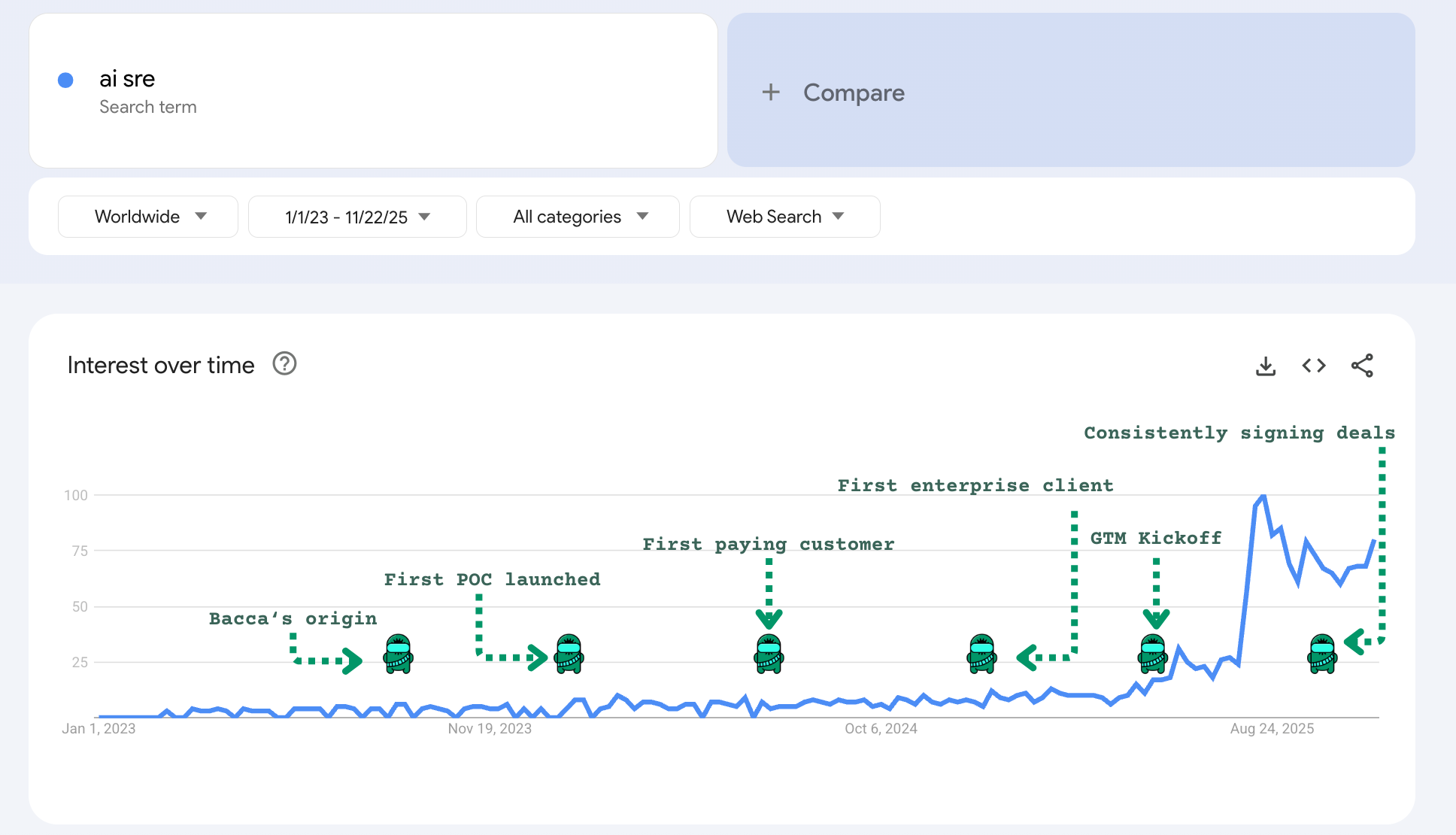
For a long time, this category was invisible. But as the Google Trends data below shows, searches for the term AI SRE dramatically increased in late 2025. We have been building Bacca in this space since early 2023, watching the narrative shift in real-time on the ground.
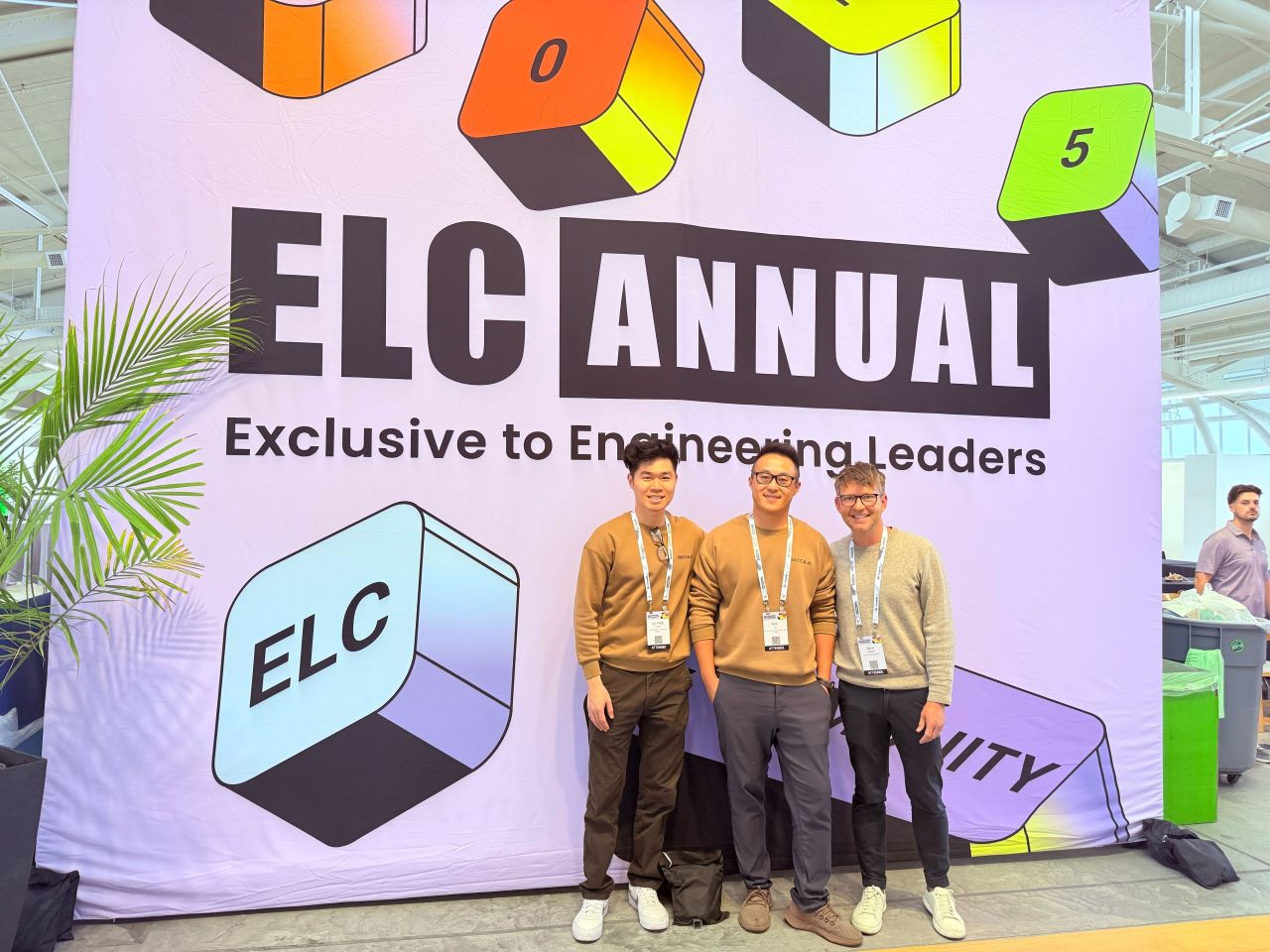
Just several months ago, at the ELC (Engineering Leadership Community) conference, vibe coding and GenAI dominated the engineering conversation.
Fast forward to AWS re:Invent. The spike in search interest you see on the chart also materialized in the real world. AI SRE and incident management were hot buzzwords. The industry has realized operating code at scale is the real bottleneck to be solved.
Why does this $10 billion gap still exist if the problem is so obvious?
Awareness ≠ Investment.
We are seeing a correction in interest around AI operations, but we are still living with the legacy of a funding environment that poured billions into the "first mile" of AI software development without fully understanding the underlying complexities that make software operations significantly harder.
In our experience, two fundamental friction points are at play:
1. Generation Gets the Glory
Generative coding demos are fun. They feel like magic. It is easy to sell the dream of "typing a prompt and getting an app." This is where the hype lives.
Operations, maintenance, and reliability? That is invisible work. It is unappreciated—until the system breaks. Nobody gets promoted for the incident that didn't happen. As a result, capital has chased the visible magic of generation and ignored the invisible discipline of reliability.
2. Ops is Context-Dependent (The Harder Problem)
Generating code is a universal problem. A Large Language Model (LLM) trained on public repositories can predict the next token for a Python function just as well for a startup as it can for a Fortune 500 company.
Code operations, on the other hand, is highly context-specific. Predicting the next line of code is a statistical problem; predicting why your server crashed is a contextual one. To be useful, an AI SRE tool cannot just be a wrapper around a generic model; it must understand your legacy stack, your "implicit data dependencies," and the historical context of why a decision was made three years ago.
Building solutions to understand that context is a fundamentally heavier lift—and a harder investment thesis—than just predicting the next token.
The Market Map
Below is the current marketplace of AI DevOps tools (and the categories they belong to). Send me a LinkedIn message if you want a copy of the underlying data.
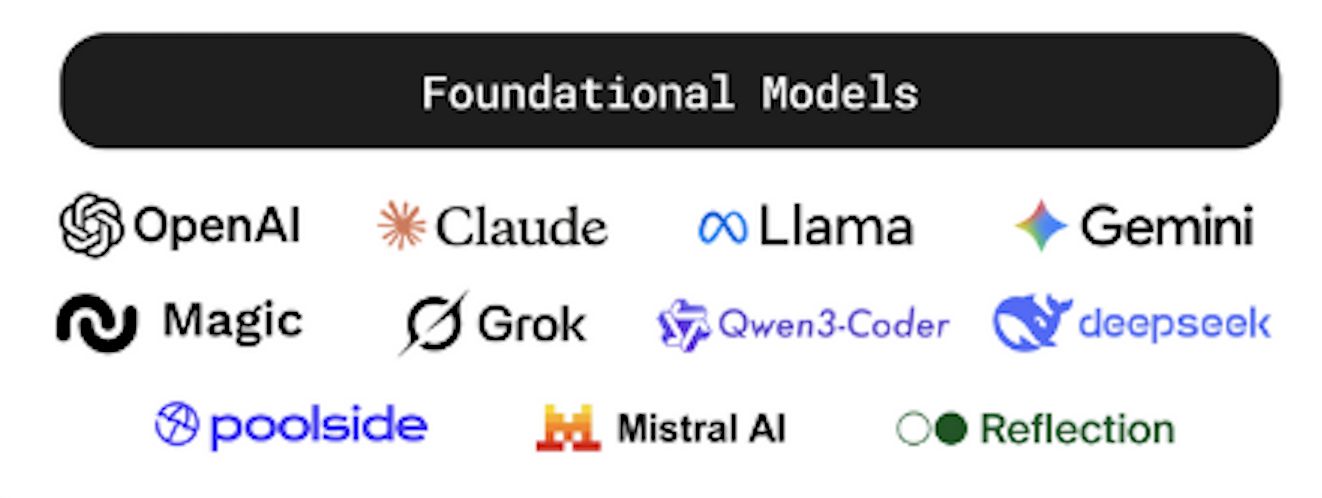
Foundational Models
OpenAI, Claude, Llama, Gemini, Magic, Grok, Qwen, DeepSeek, Poolside, Mistral AI, Reflection
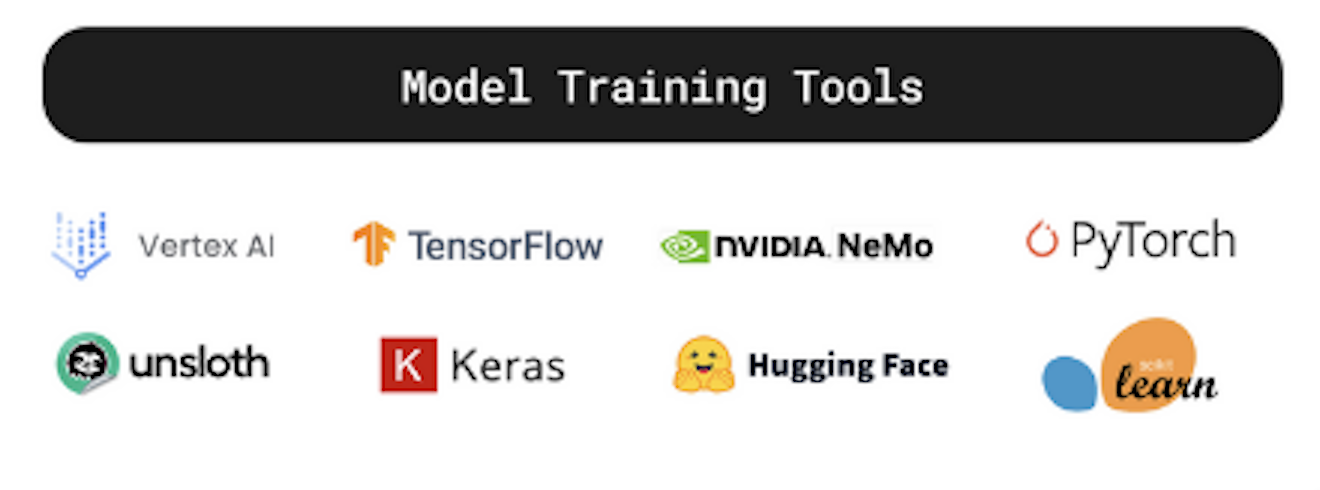
Model Training Tools
Vertex AI, TensorFlow, NVIDIA NeMo, PyTorch, Unsloth, Keras, Hugging Face, Scikit-Learn
Planning & Design
Code Intelligence & Documentation: GitButler, DocuWriter.ai, Dosu, Mintlify, Pieces for Developers, Sourcegraph, Unblocked
Prototyping: Figma, Google AI Studio, Canva, Lucidchart, DiagramGPT

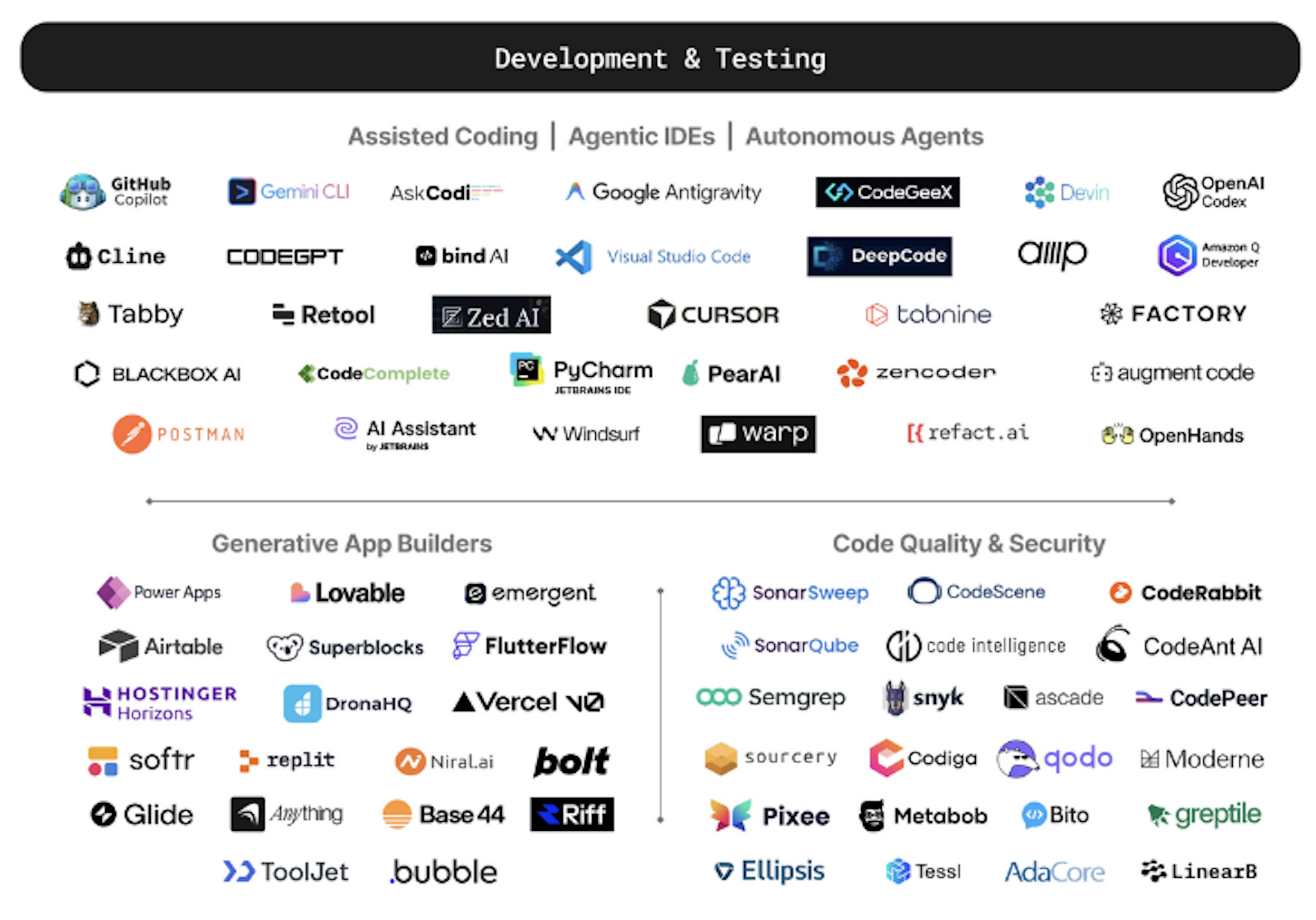
Development & Testing
Assisted Coding | Agentic IDEs | Autonomous Agents: GitHub Copilot, Gemini CLI, AskCodi, Google Antigravity, CodeGeex, Devin, OpenAI Codex, Cline, CodeGPT, Bind AI, Visual Studio Code, DeepCode, Ellipsis, Amazon Q Developer, Tabby, Retool, Zed AI, Cursor, Tabnine, Factory, Blackbox AI, CodeComplete, PyCharm, PearAI, Zencoder, Augment Code, Postman, AI Assistant by JetBrains, Windsurf, Warp, Refact.ai, OpenHands
Generative App Builders: Power Apps, Lovable, Emergent, Airtable, Superblocks, FlutterFlow, Hostinger Horizons, DronaHQ, Vercel v0, Softr, Replit, Niral.ai, Bolt, Glide, AnyThing, Base44, Riff, ToolJet, Bubble
Code Quality & Security: SonarSweep, CodeScene, CodeRabbit, SonarQube, Code Intelligence, CodeAnt AI, Semgrep, Snyk, Ascade (Likely Aikido), CodePeer, Sourcery, Codiga, Qodo, Moderne, Pixee, Metabob, Bito, Greptile, Tessl, AdaCore, LinearB
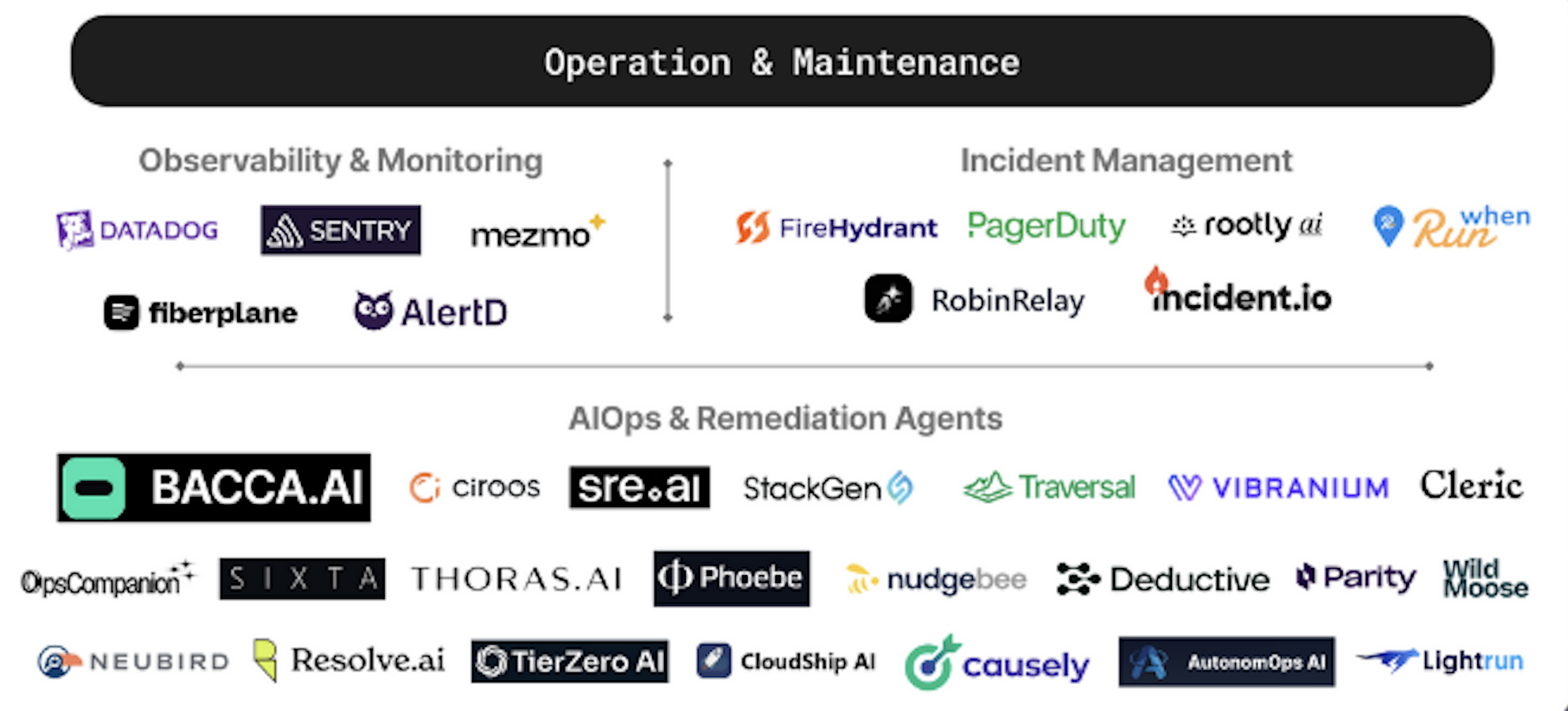
Operation & Maintenance
Observability & Monitoring: Datadog, Sentry, Mezmo, Fiberplane, AlertD
Incident Management: FireHydrant, PagerDuty, Rootly, RunWhen, RobinRelay, Incident.io
AIOps & Remediation Agents: Bacca.AI, Ciroos, Sre.ai, StackGen, Traversal, Vibranium, Cleric, OpsCompanion, Sixta, Thoras.ai, Phoebe, Nudgebee, Deductive, Parity, Wild Moose, Neubird, Resolve.ai, TierZero AI, CloudShip AI, Causely, AutomOps AI, Lightrun
While we’re finally making headway in the amount of tools available for solving operational problems, there’s still a massive imbalance in the capital being invested in code generation vs. ops and maintenance.
We are deploying a mountain of code that no single human fully understands into systems that are already too complex for humans to manage alone. Who’s on call at 3 AM when that AI-generated code breaks?
Right now, we rely on senior engineers who know where institutional knowledge is buried to save the day. But the more AI code becomes the norm, the harder it will be for human engineers to manage all the hidden context.
Want to see where the money is going in the AI DevOps landscape?
DM me on LinkedIn to continue the conversation and/or to request a copy of the underlying data.
Eric Lu, Founder & CEO
we will contact you soon